
图
图
在生命旅途中,我们就像是一个个节点,被无数看不见的边相连。每一次的相识与相遇,都在这张巨大的网络途中留下独特的印记。
图
图(graph)是一种非线性数据结构,由 顶点(vertex) 和 边(edge) 组成,我们可以将图 G 抽象地表示为一组由顶点 V 和边 E 组成的集合。
V={1,2,3,4,5}
E={(1,2),(1,3),(2,3),(2,4),(3,4),(3,5),(4,5)}
G={V,E}
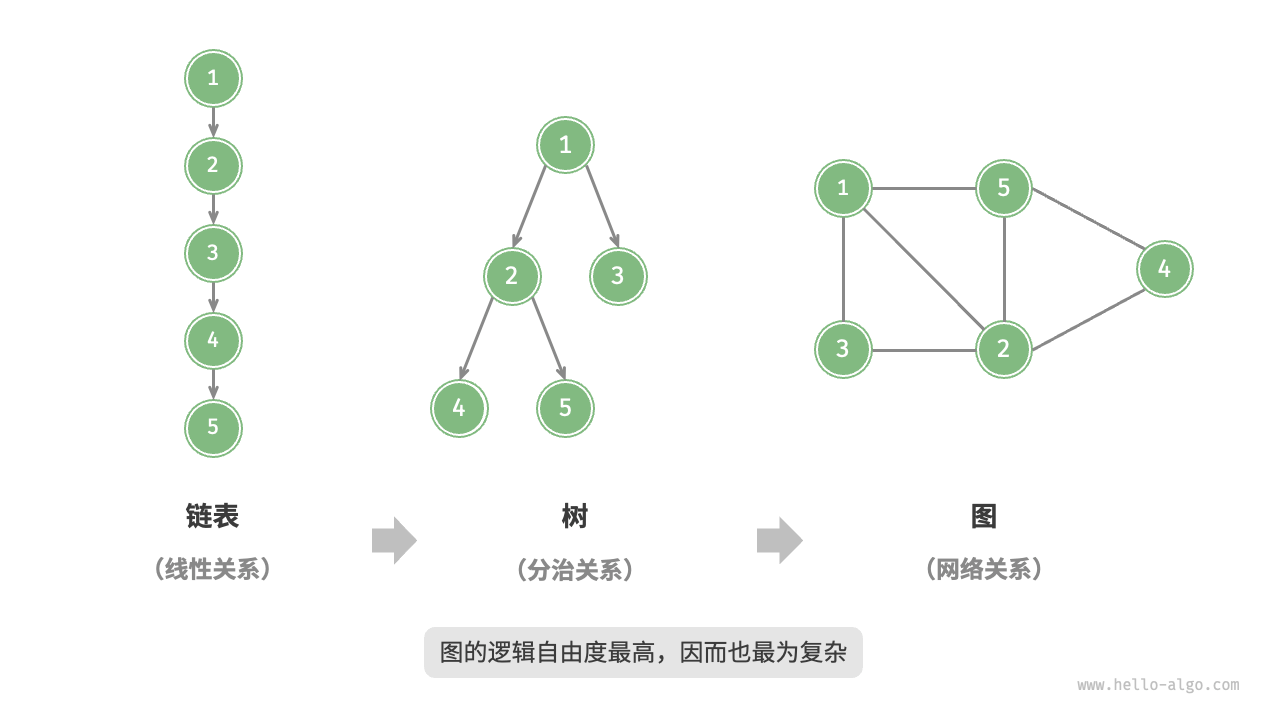
若将顶点看作节点,将边看作连接各个节点的引用,我们也可以将图看作一种从链表扩展而来的数据结构。相对于线性关系(链表)和分治关系(树)来说,网络关系(图)的自由度更高,也更加复杂。
图的常见类型与术语
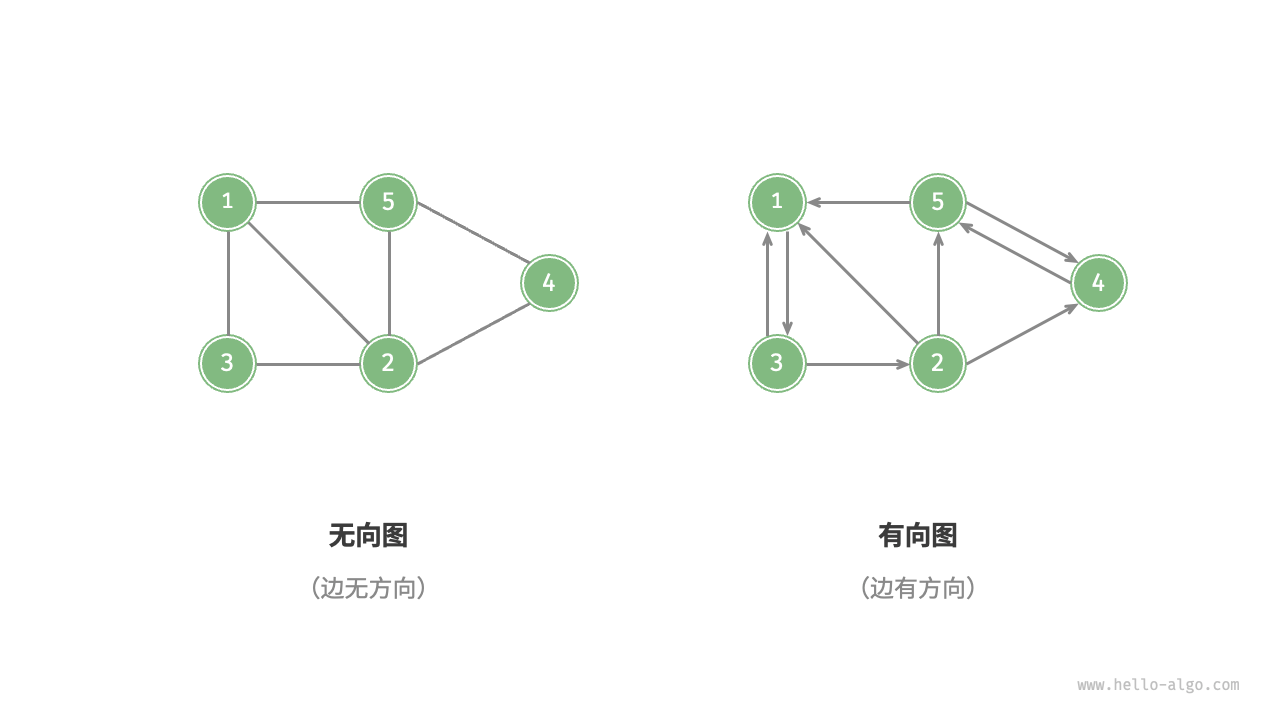
根据边是否具有方向,分为 无向图 和 有向图,具体区别如下:
- 在无向图中,边表示两顶点之间的“双向”连接关系。
- 在有向图中,边具有方向性,即 A->B 和 A<-B 两个方向的边是相互独立的。
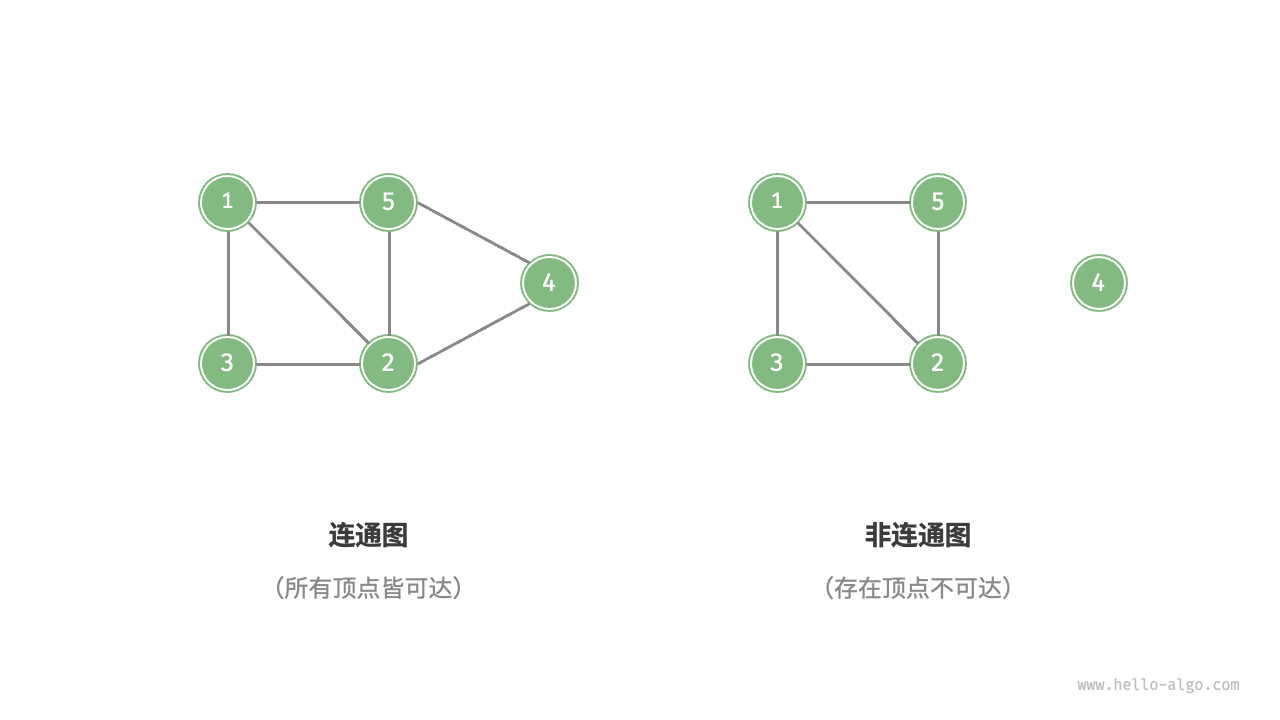
根据所有顶点是否相通,分为 连通图 和 非连通图,区别如下:
- 对于连通图,从某个顶点出发,可以到达任意一个顶点。
- 对于非连通图,从某个顶点出发,至少有一个顶点无法到达。
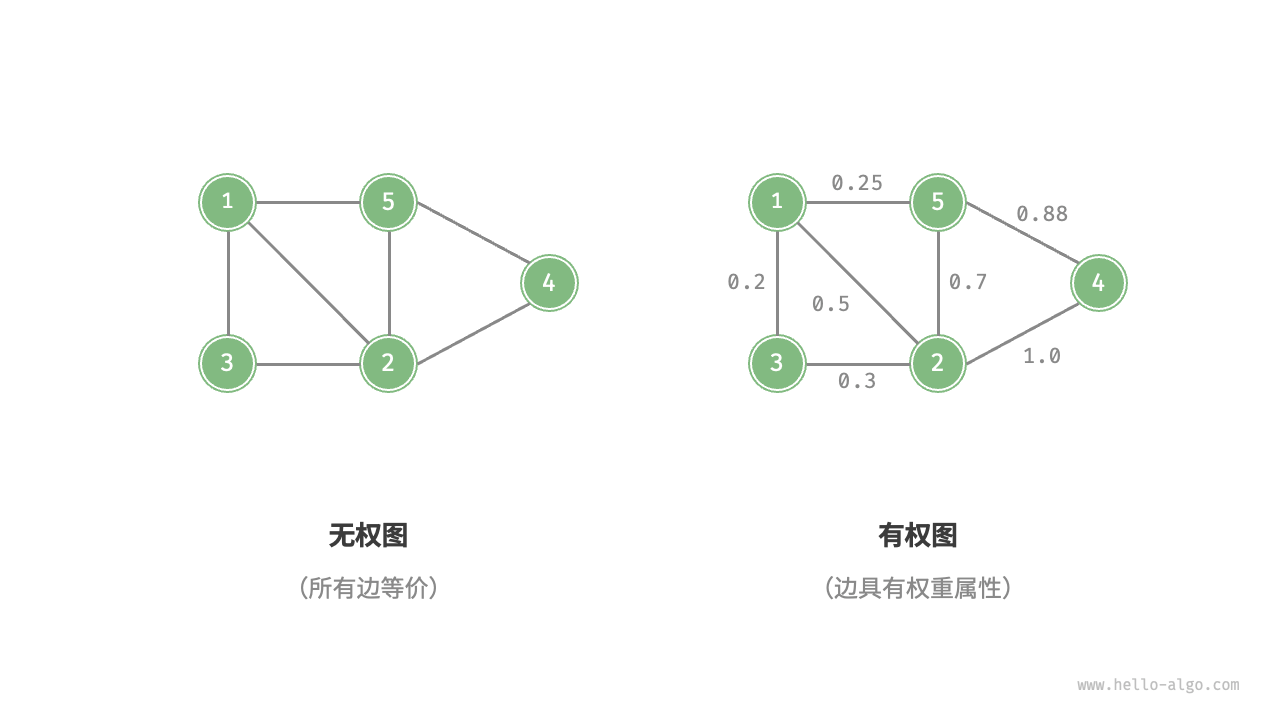
还可对边进行加权
图数据结构包含以下常用术语:
- 邻接:当两顶点之间存在边相连时,称这两顶点“邻接”。
- 路径:从顶点A到顶点B所经过的边构成的序列被称为从A到B的“路径”。
- 度:一个顶点拥有的边数。对于有向图,入度 表示有多少条边指向该顶点,出度表示有多少条边从该顶点指出。
图的表示
图的常用表示方式包括“邻接矩阵”和“邻接表”
1. 邻接矩阵
设图的顶点数量为n,邻接矩阵使用一个n*n大小的矩阵来表示图,每一行代表一个顶点,矩阵元素代表边,使用0和1表示两个顶点之间是否存在边。
假设邻接矩阵为M,顶点列表为V,那么矩阵元素M[i,j]=1,表示顶点V[i]和V[j]之间存在边。,反之m[i,j]=0代表两顶点之间不存在边。
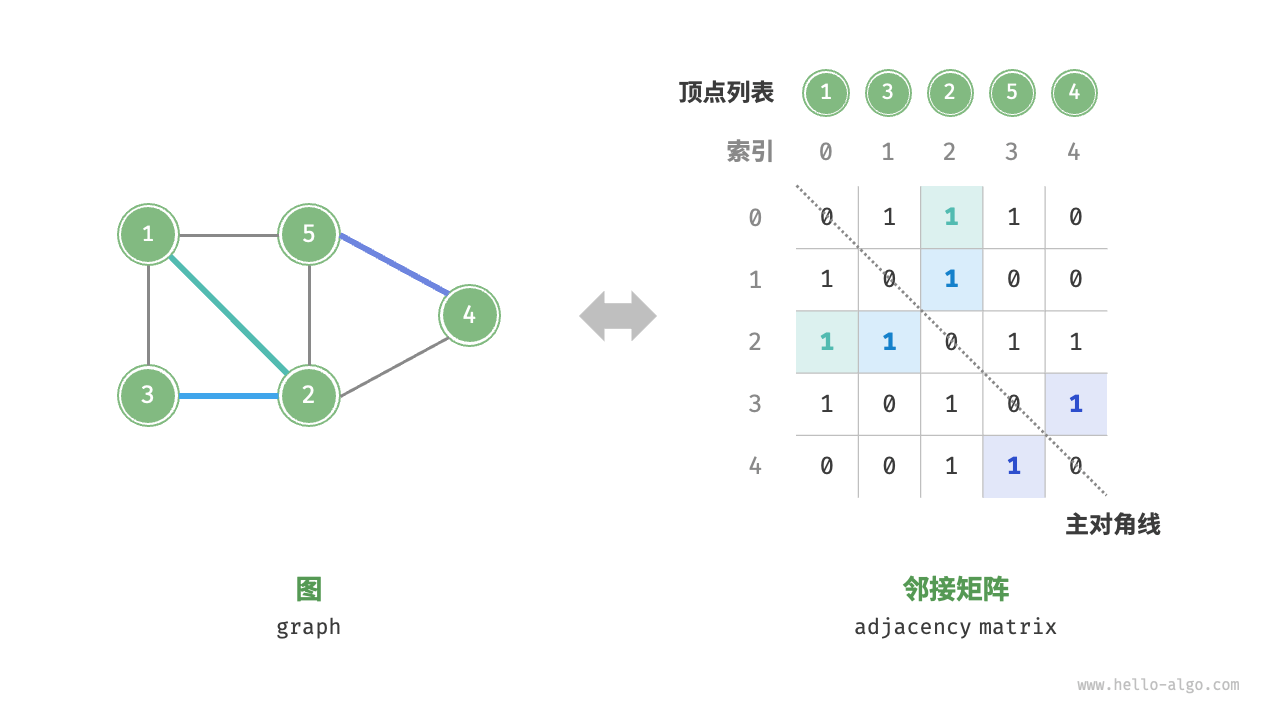
邻接矩阵具有以下特性:
- 顶点不能与自身相连,因此邻接矩阵主对角线元素没有意义。
- 对于无向图,两个方向的边等价,此时邻接矩阵关于主对角线对称。
- 将邻接矩阵的元素从1和0替换为权重,则可表示有权图。
使用邻接矩阵表示图时,我们可以直接访问矩阵元素以获取边,因此增删改查效率很高,时间复杂度均为O(1),但是空间复杂度为O(n^2),内存占用较多。
2. 邻接表
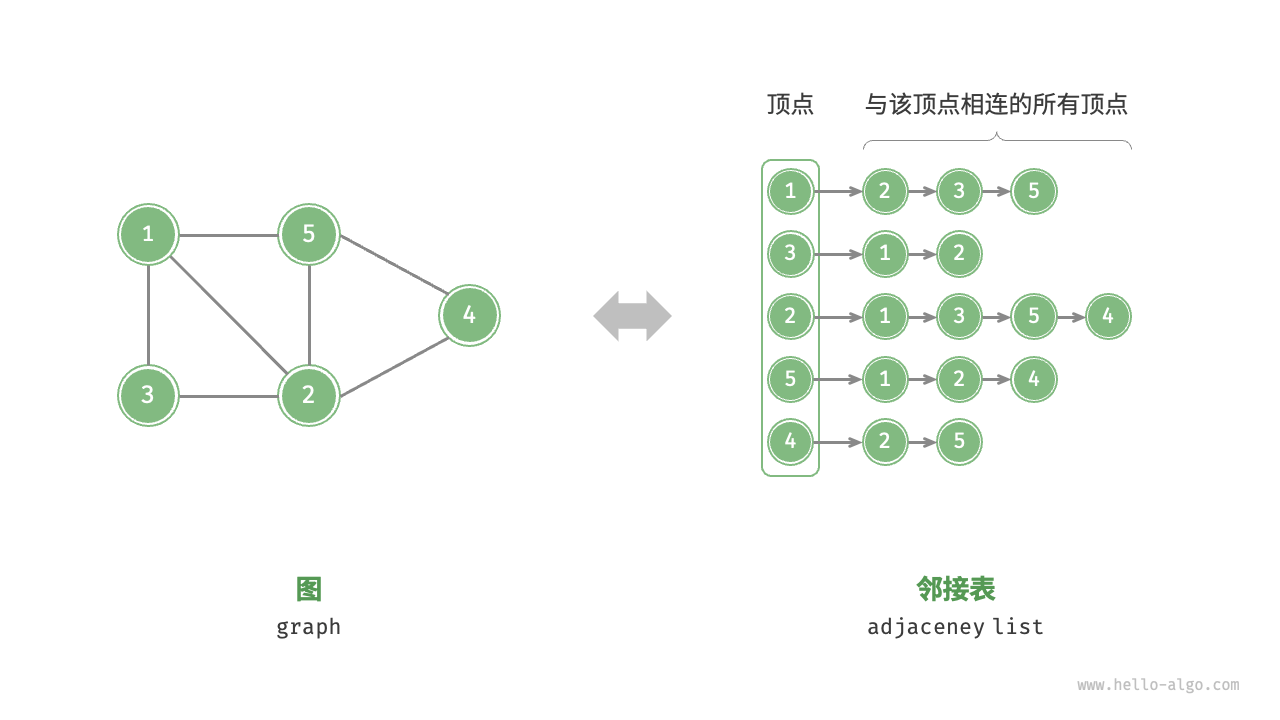
邻接表使用n各链表来表示图,链表节点表示顶点。第i个链表对应顶点i,其中存储了该顶点的所有邻接顶点。
邻接表仅存储实际存在的表,而边的总数通常远小于n^2,因此它更加节省空间,但是由于是存储在链表中,它需要通过遍历链表来查找边,因此时间效率不如邻接矩阵。
图的基本操作
图的基本操作可分为对“边”的操作和对“顶点”的操作,在邻接矩阵和邻接表两种表示方法下,实现方式有所不同。
基于邻接矩阵的实现
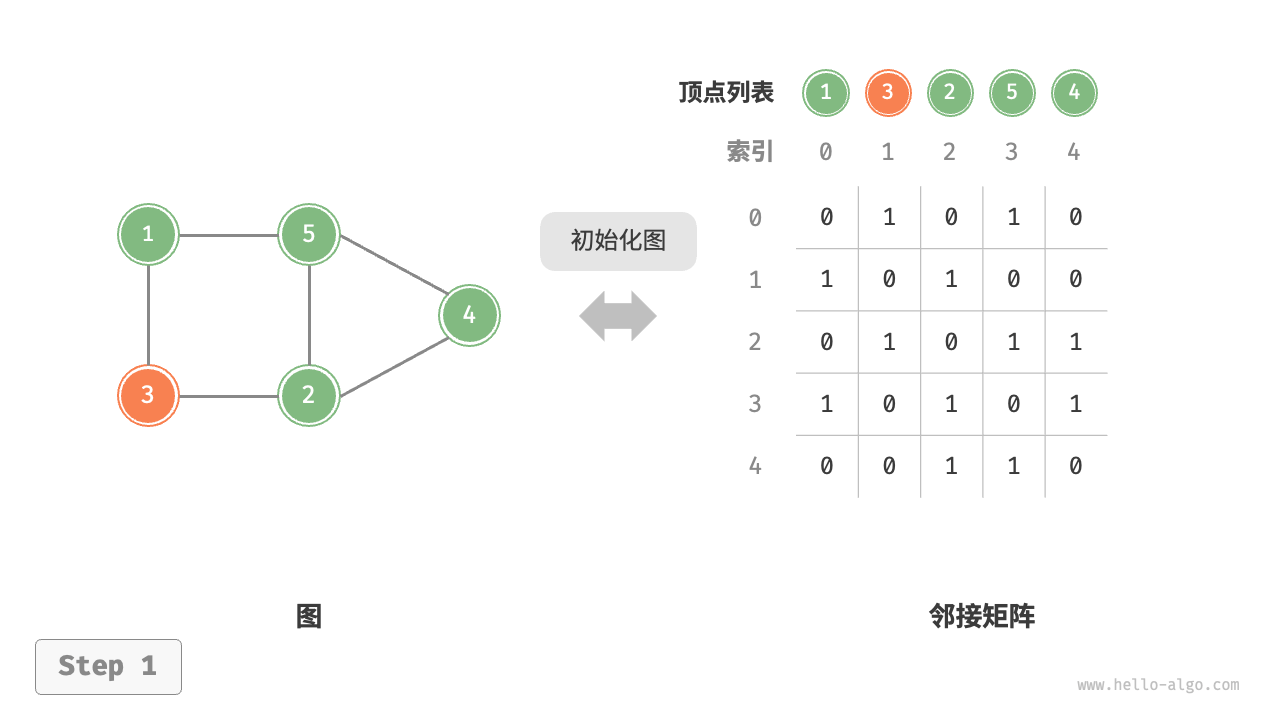
给定一个顶点数量为n的无向图,对图的操作如下:
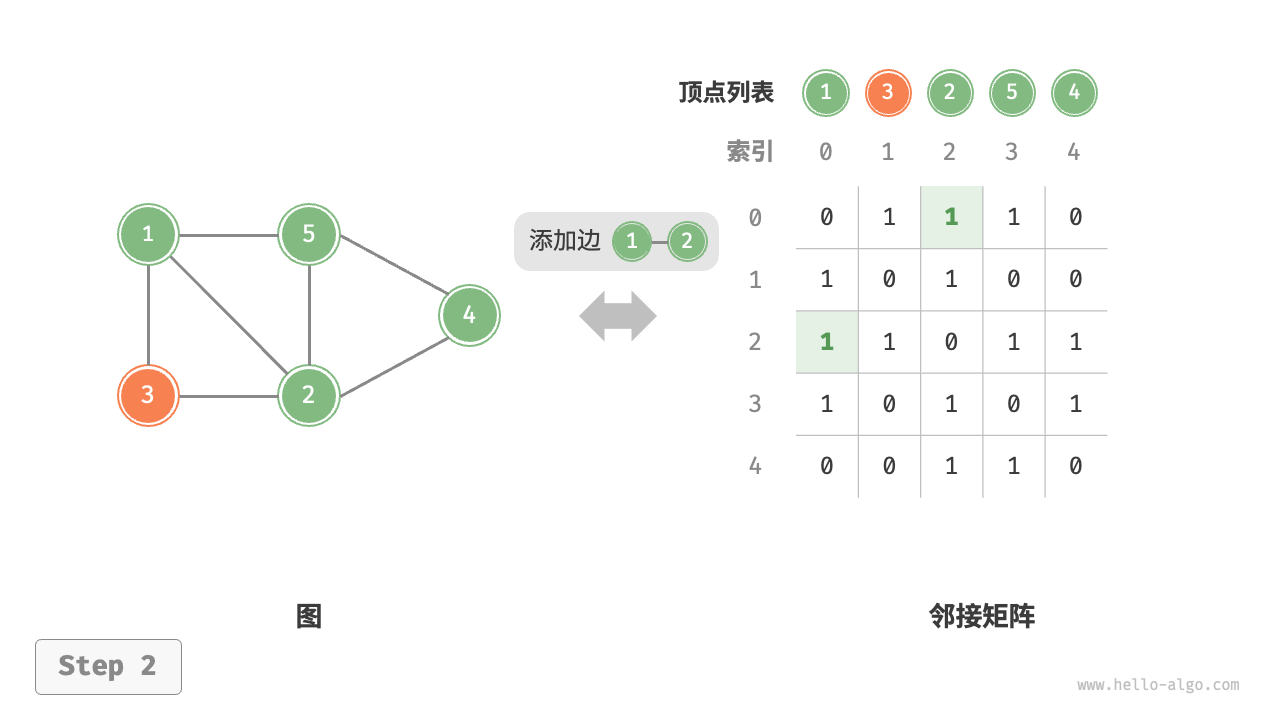
- 添加或删除边:直接在邻接矩阵中修改指定的边即可,使用O(1)时间,由于是无向的,因此需要同时更新两个方向的边。
- 添加顶点:在邻接矩阵的尾部添加一行一列,并全部填0即可,使用O(n)时间。
- 删除顶点:在邻接矩阵中删除一行一列,当删除首行首列时达到最差情况,需要将(n-1)2个元素“向左上移动”,使用O(n2)时间。
- 初始化:传入n个顶点,初始化长度为n的顶点列表vertices,使用O(n)的时间,初始化n x n大小的邻接矩阵adjMat,使用O(n^2)时间。
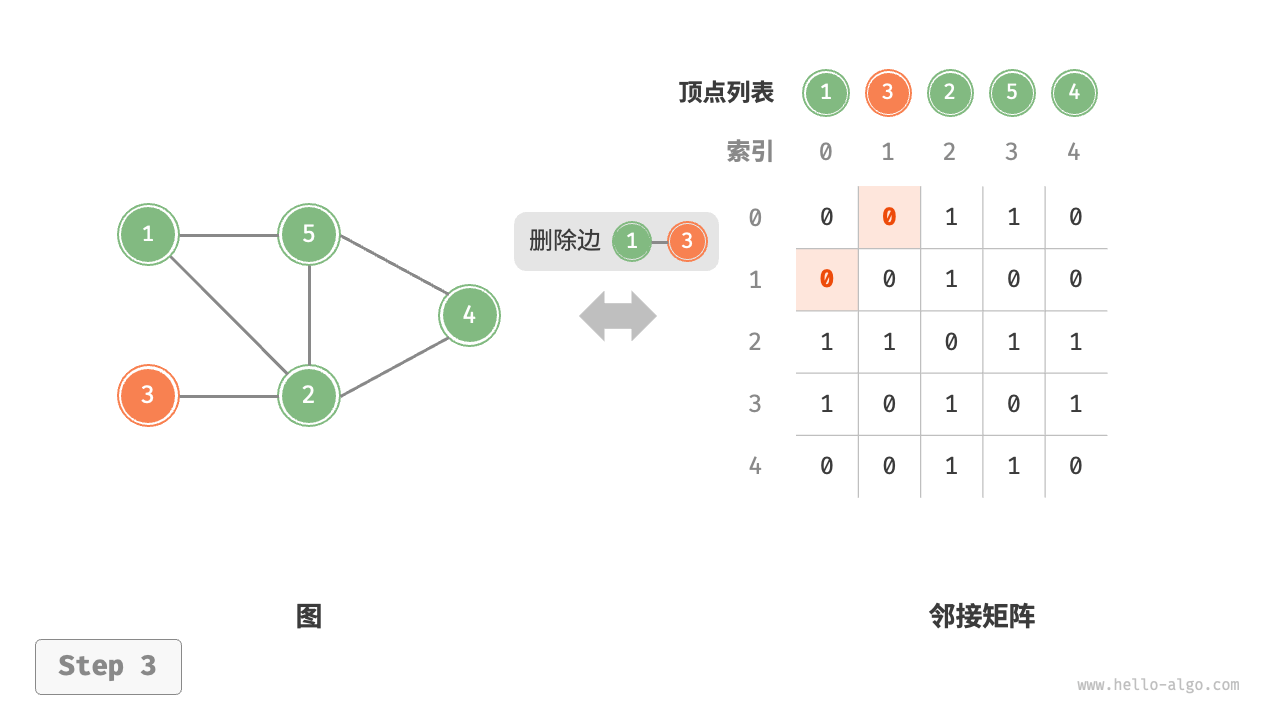
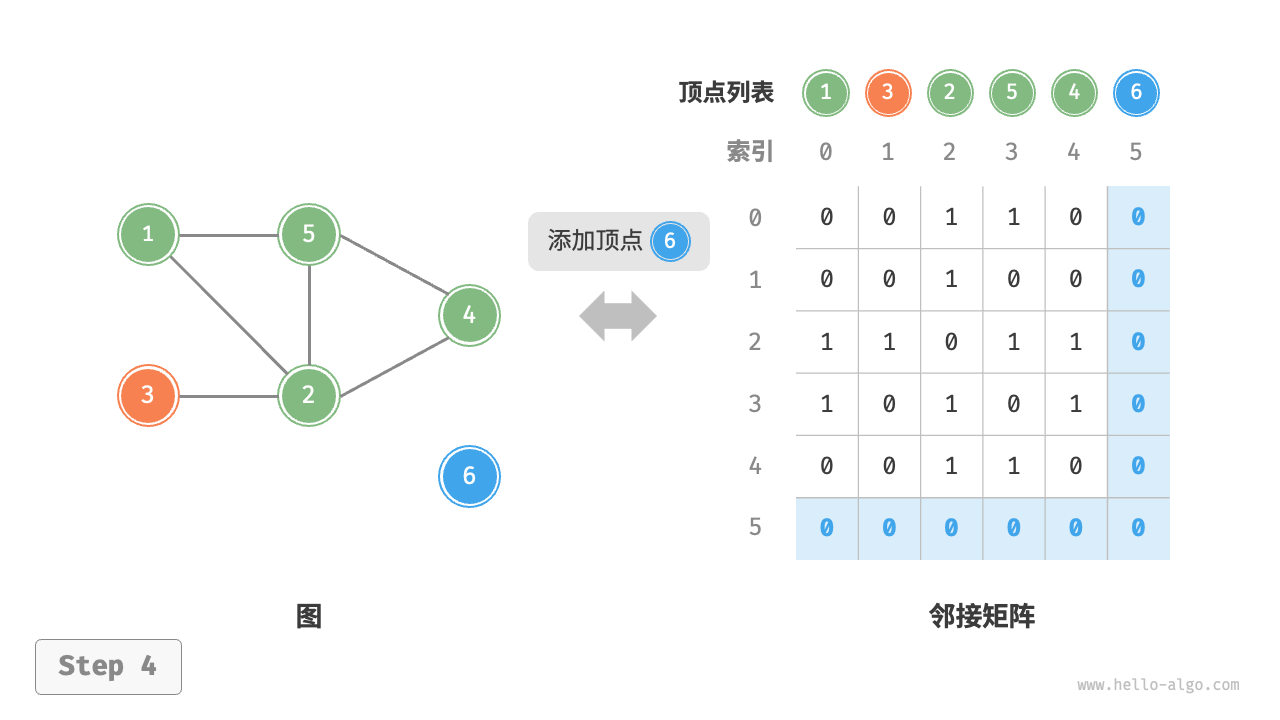
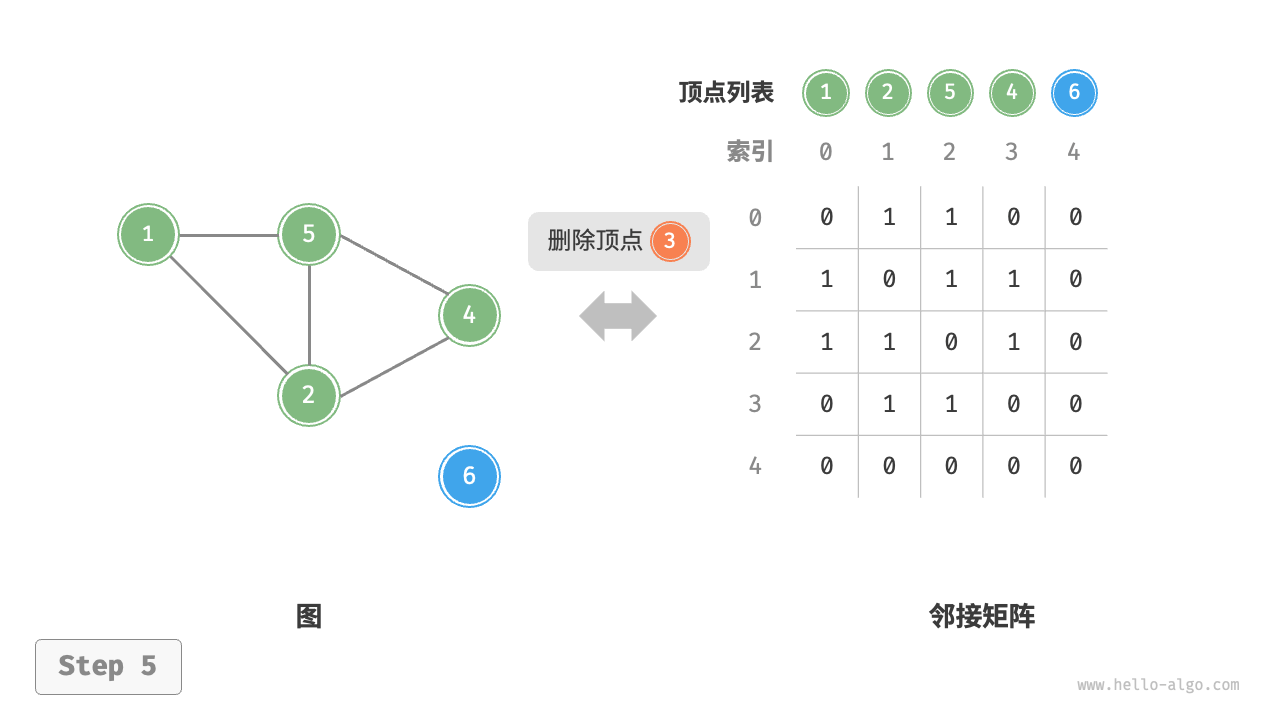
/**
 * 基于邻接矩阵实现图的操作
 */

class Graph {
	vertices; // 顶点列表
	adjMat; // 邻接矩阵

	constructor(vertices, edges) {
		this.vertices = [];
		this.adjMat = [];

		// 添加顶点
		for (const val of vertices) {
			// 指向单个添加顶点
			this.addVertex(val);
		}

		// 添加边,edges内含相互有边的顶点,将0改为1
		for (const e of edges) {
			this.addEdge(e[0], e[1]);
		}
	}

	// 获取大小
	size() {
		return this.vertices.length;
	}

	// 添加顶点:添加一行一列,全部填0
	addVertex(val) {
		let n = this.size();
		// 先将值推入顶点列表中
		this.vertices.push(val);
		// 在邻接矩阵中添加一行
		const newRow = [];
		for (let j = 0; j < n; j++) {
			newRow.push(0);
		}
		this.adjMat.push(newRow);
		// 在邻接矩阵中添加一列
		for (const row of this.adjMat) {
			row.push(0);
		}
	}
	/* 删除顶点 */
	removeVertex(index) {
		if (index >= this.size()) {
			throw new RangeError("Index Out Of Bounds Exception");
		}
		// 在顶点列表中移除索引 index 的顶点
		this.vertices.splice(index, 1);

		// 在邻接矩阵中删除索引 index 的行
		this.adjMat.splice(index, 1);
		// 在邻接矩阵中删除索引 index 的列
		for (const row of this.adjMat) {
			row.splice(index, 1);
		}
	}

	/* 添加边 */
	// 参数 i, j 对应 vertices 元素索引
	addEdge(i, j) {
		// 索引越界与相等处理
		if (i < 0 || j < 0 || i >= this.size() || j >= this.size() || i === j) {
			throw new RangeError("Index Out Of Bounds Exception");
		}
		// 在无向图中,邻接矩阵关于主对角线对称,即满足 (i, j) === (j, i)
		this.adjMat[i][j] = 1;
		this.adjMat[j][i] = 1;
	}

	/* 删除边 */
	// 参数 i, j 对应 vertices 元素索引
	removeEdge(i, j) {
		// 索引越界与相等处理
		if (i < 0 || j < 0 || i >= this.size() || j >= this.size() || i === j) {
			throw new RangeError("Index Out Of Bounds Exception");
		}
		this.adjMat[i][j] = 0;
		this.adjMat[j][i] = 0;
	}

	/* 打印邻接矩阵 */
	print() {
		console.log("顶点列表 = ", this.vertices);
		console.log("邻接矩阵 =", this.adjMat);
	}
}

const gragp = new Graph(
	[1, 2, 3, 4],
	[
		[0, 1],
		[0, 2],
		[2, 3],
	]
);

gragp.print();
基于邻接表的实现
设无向图的顶点总数为n,边总数为m,则图的各项操作如下:
- 初始化:在邻接表中创建n个顶点和2m条边,使用O(n+2m)的时间。
- 添加边:在顶点对应链表的末尾添加边即可,使用O(1)的时间,由于是无向图,所有需要同时添加两个方向的边。
- 删除边:在顶点对应链表中查找并删除指定的边,使用O(m)的时间,在无向图中,需要同时删除两个方向的边。
- 添加顶点:在邻接表中添加一个链表,并将新增的顶点作为链表头节点,使用O(1)的时间。
- 删除顶点:需遍历整个邻接表,删除包含指定顶点的所有边,使用O(n+m)的时间。
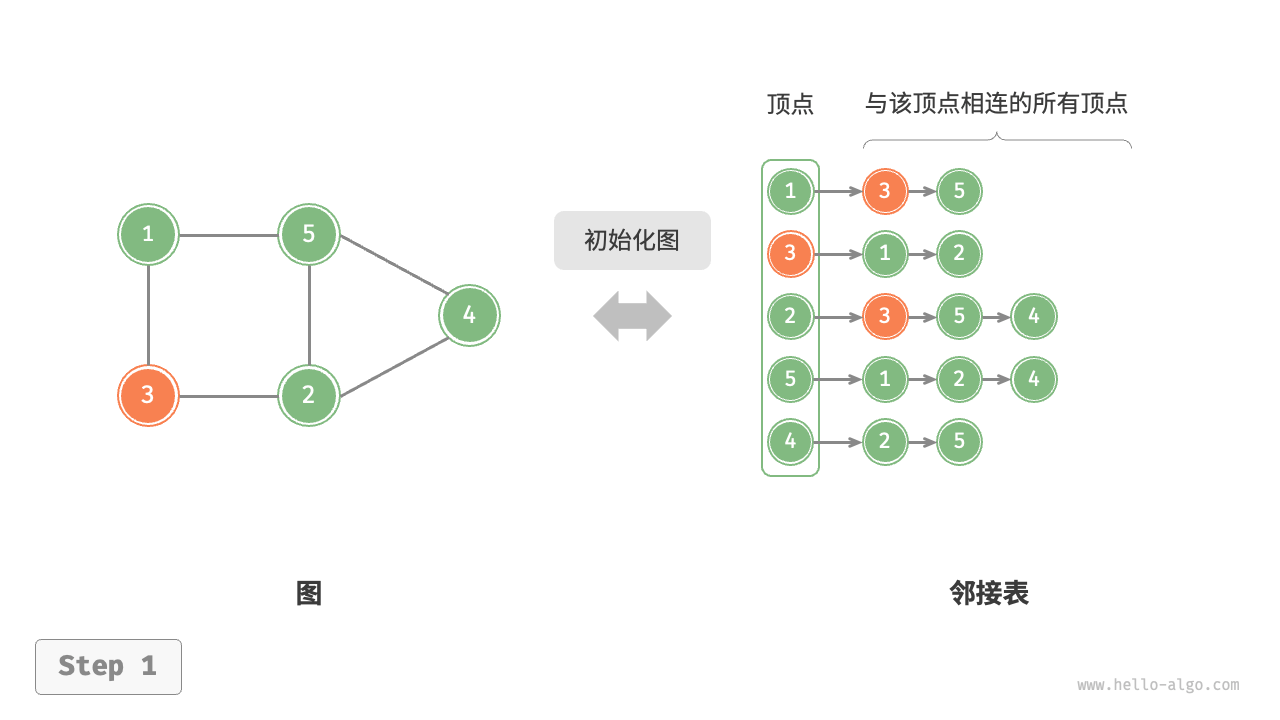
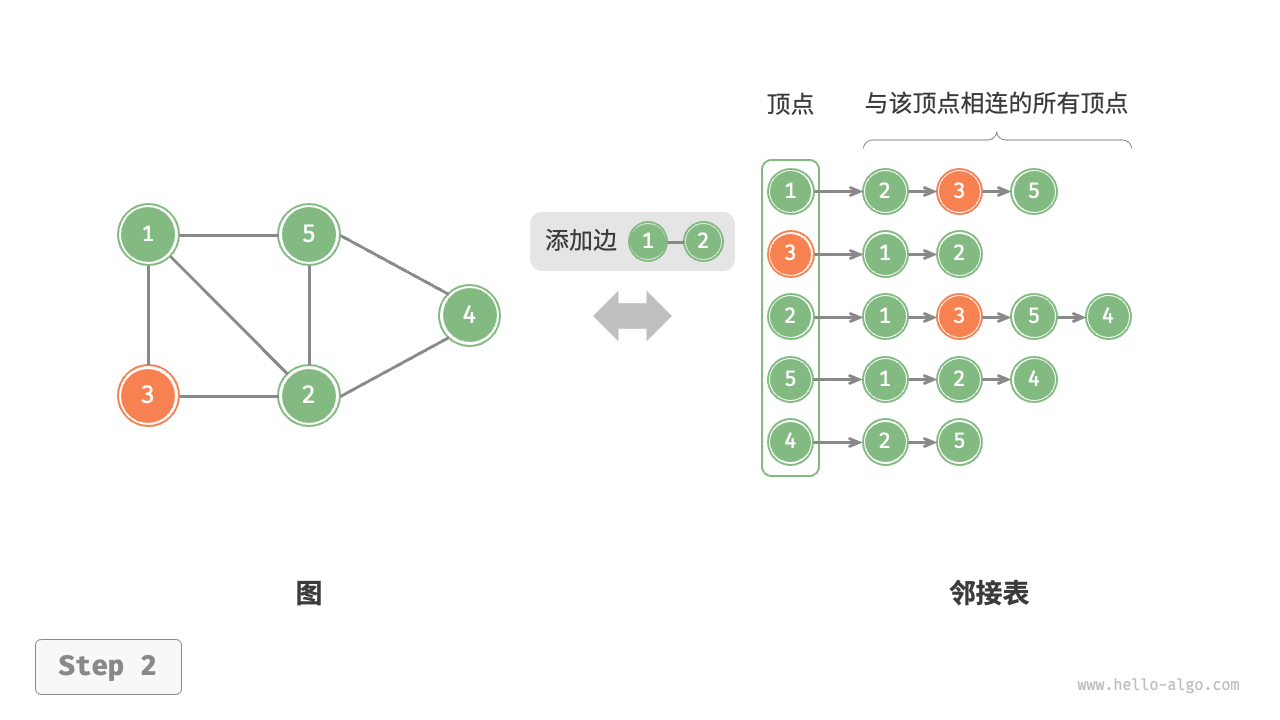
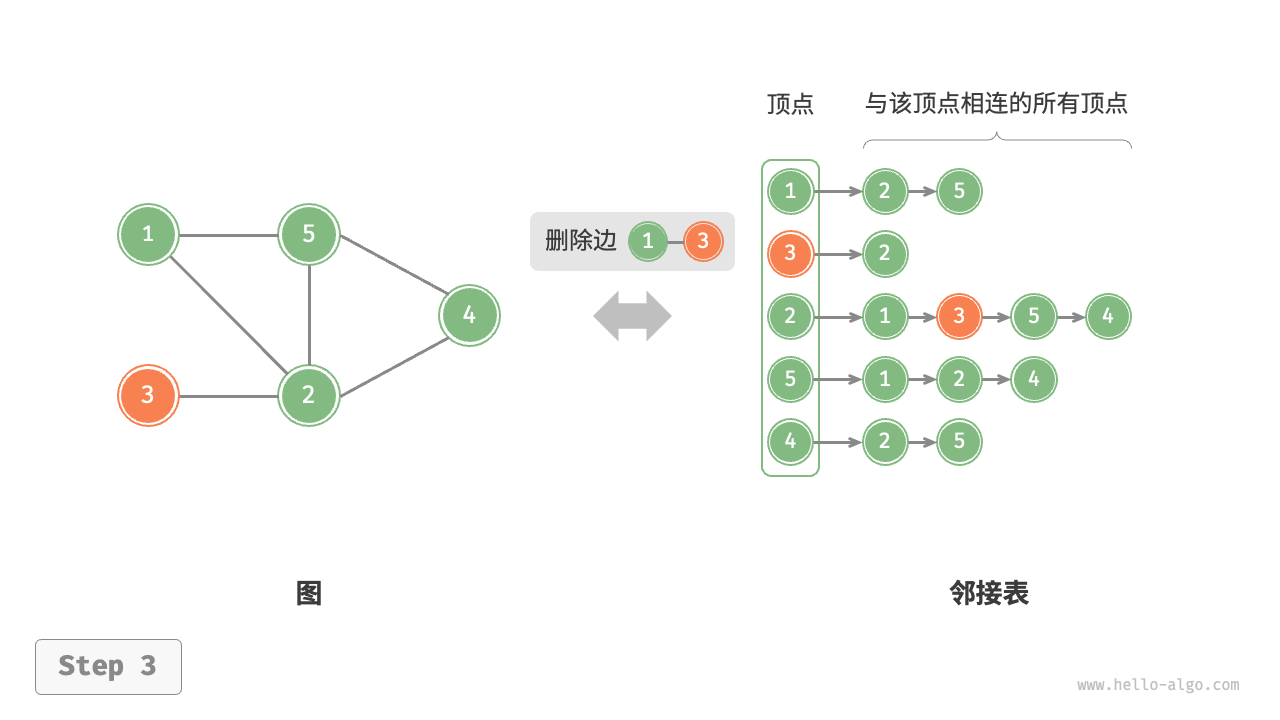
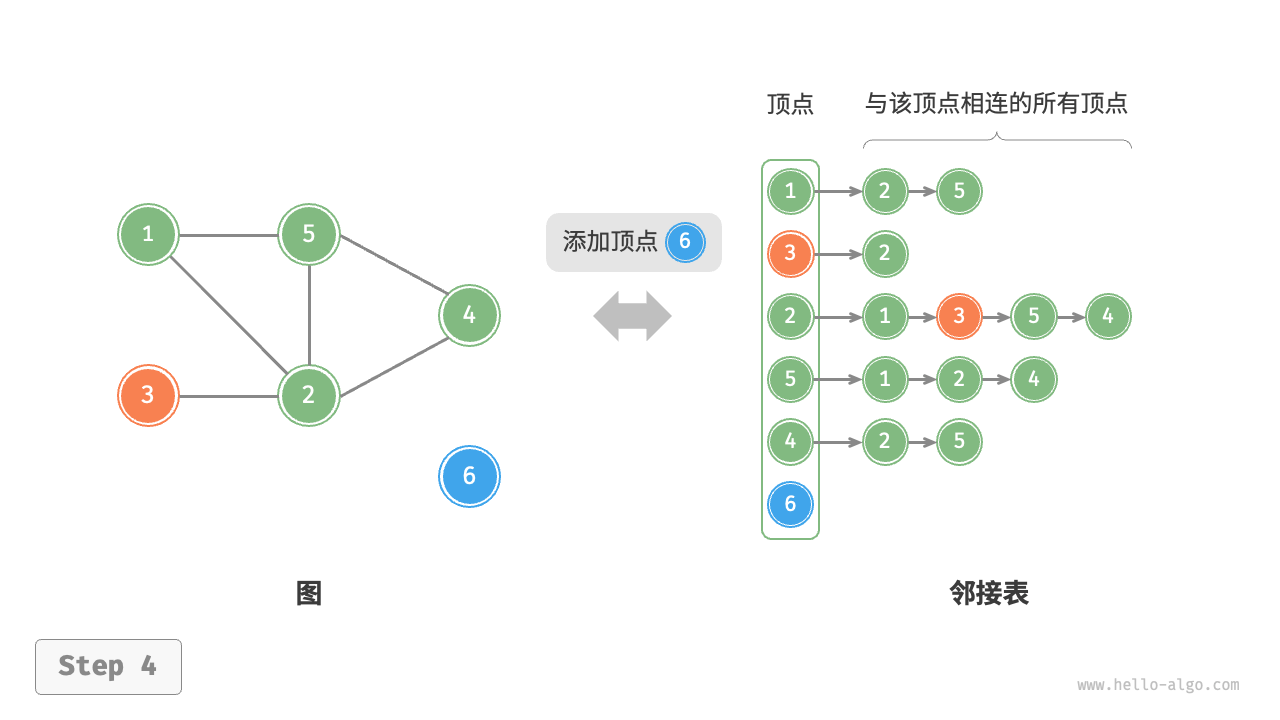
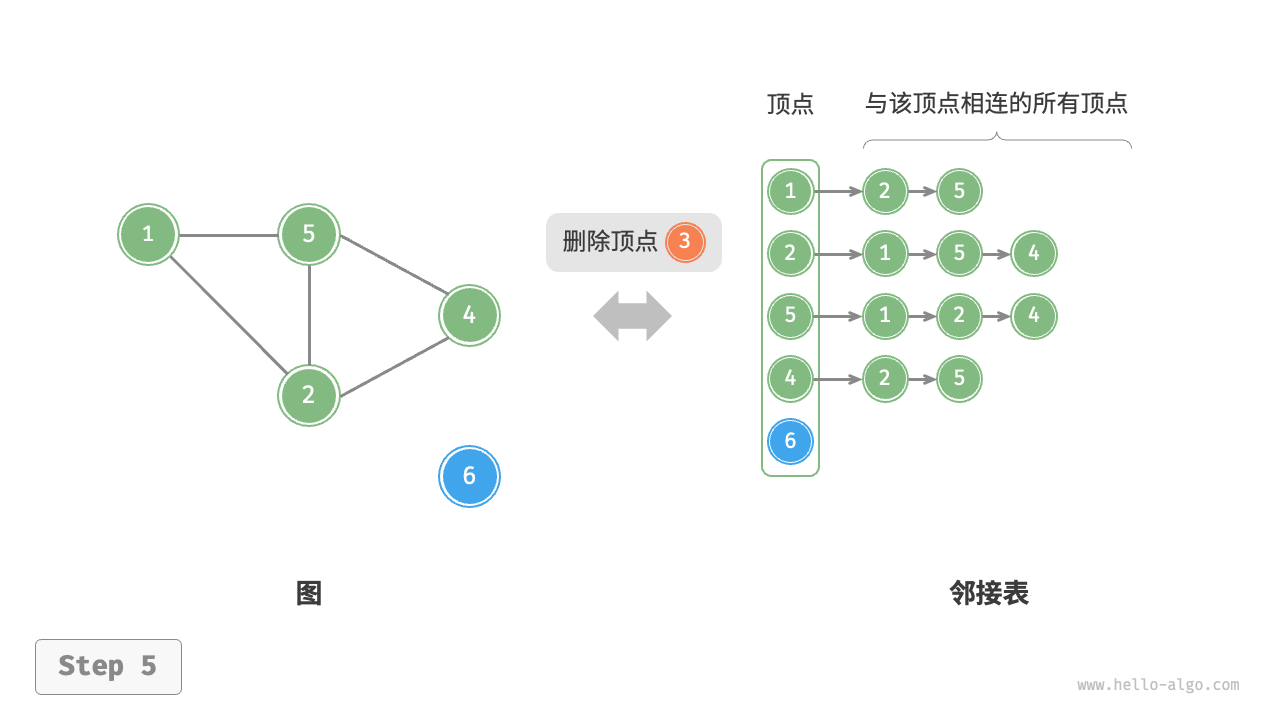 、
、
/**
 * 基于邻接表来实现图的操作
 */

class Graph {
	adjList;

	// 边
	constructor(edges = []) {
		this.adjList = new Map();

		for (const edge of edges) {
			// 添加顶点
			this.addVertex(edge[0]);
			this.addVertex(edge[1]);

			// 添加边
			this.addEdge(edge[0], edge[1]);
		}
	}

	// 添加顶点
	addVertex(v) {
		if (this.adjList.has(v)) return;
		this.adjList.set(v, []);
	}
	/* 删除顶点 */
	removeVertex(vet) {
		if (!this.adjList.has(vet)) {
			throw new Error("Illegal Argument Exception");
		}
		// 在邻接表中删除顶点 vet 对应的链表
		this.adjList.delete(vet);
		// 遍历其他顶点的链表,删除所有包含 vet 的边
		for (const set of this.adjList.values()) {
			const index = set.indexOf(vet);
			if (index > -1) {
				set.splice(index, 1);
			}
		}
	}
	// 添加边
	addEdge(vet1, vet2) {
		if (
			!this.adjList.has(vet1) ||
			!this.adjList.has(vet2) ||
			vet1 === vet2
		) {
			throw new Error("Illegal Argument Exception");
		}
		// 添加边 vet1 - vet2
		this.adjList.get(vet1).push(vet2);
		this.adjList.get(vet2).push(vet1);
	}

	// 删除边
	removeEdge(vet1, vet2) {
		if (
			!this.adjList.has(vet1) ||
			!this.adjList.has(vet2) ||
			vet1 === vet2
		) {
			throw new Error("Illegal Argument Exception");
		}
		// 删除边 vet1 - vet2
		this.adjList.get(vet1).splice(this.adjList.get(vet1).indexOf(vet2), 1);
		this.adjList.get(vet2).splice(this.adjList.get(vet2).indexOf(vet1), 1);
	}

	/* 打印邻接表 */
	print() {
		console.log("邻接表 =");
		console.log(this.adjList);
		for (const [key, value] of this.adjList) {
			console.log(key, value);
			const tmp = [];
			for (const vertex of value) {
				tmp.push(vertex);
			}
			console.log(key + ": " + tmp.join());
		}
	}

	/* 获取顶点数量 */
	size() {
		return this.adjList.size;
	}
}

let gragp = new Graph([
	["A", "B"],
	["A", "C"],
	["A", "D"],
	["B", "E"],
	["B", "F"],
	["C", "G"],
	["D", "H"],
	["E", "I"],
	["F", "J"],
	["G", "K"],
	["H", "L"],
]);

gragp.print()
邻接矩阵体现出的是以空间换时间,邻接表则体现了以时间换空间。
图的遍历
数代表的是一对多关系,而图则有更高的自由度,可以表示任意的多对多关系,因此可以将树看作为图的特例。
图和树都需要应用搜索算法来实现遍历操作,图的遍历方式也可以分为两种:广度优先遍历和深度优先遍历。
广度优先遍历
广度优先遍历是一种由近及远的遍历方式,从某个节点触发,始终优先访问距离最近的顶点,并一层层向外扩张。
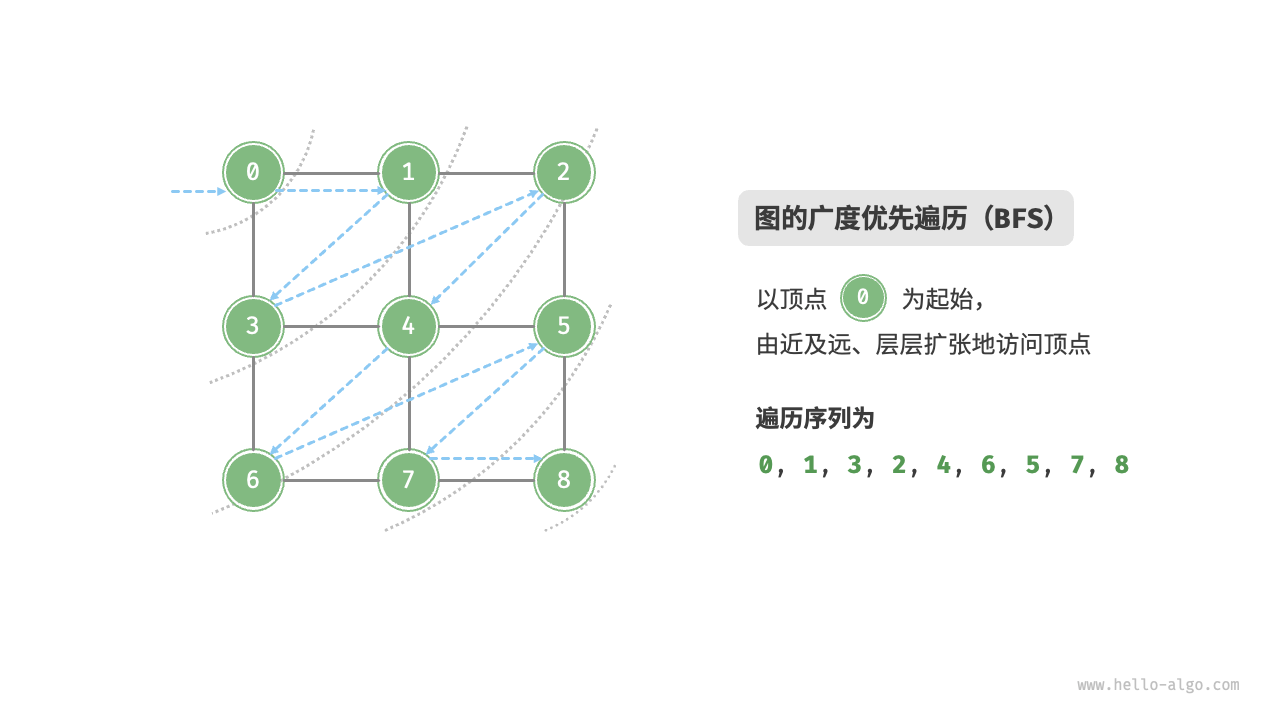
/* 广度优先遍历 */
// 使用邻接表来表示图,以便获取指定顶点的所有邻接顶点
function graphBFS(graph, startVet) {
    // 顶点遍历序列
    const res = [];
    // 哈希集合,用于记录已被访问过的顶点
    const visited = new Set();
    visited.add(startVet);
    // 队列用于实现 BFS
    const que = [startVet];
    // 以顶点 vet 为起点,循环直至访问完所有顶点
    while (que.length) {
        const vet = que.shift(); // 队首顶点出队
        res.push(vet); // 记录访问顶点
        // 遍历该顶点的所有邻接顶点
        for (const adjVet of graph.adjList.get(vet) ?? []) {
            if (visited.has(adjVet)) {
                continue; // 跳过已被访问的顶点
            }
            que.push(adjVet); // 只入队未访问的顶点
            visited.add(adjVet); // 标记该顶点已被访问
        }
    }
    // 返回顶点遍历序列
    return res;
}
复杂度分析:
- xxxxxxxxxx /** * Top-k问题 /let nums = [1, 7, 6, 3, 2];let k = 3; // 获取数组中最大的k个元素// 方法一:k轮遍历function topKMap(nums, k) { let result = []; let copy = JSON.parse(JSON.stringify(nums)); for (let i = 0; i < k; i++) { // 将数组中最大push进去, 并在数组中删除 result.push(Math.max(...copy)); copy.splice(copy.indexOf(Math.max(...copy)), 1); } console.log(result); return result;}topKMap(nums, k);// 方法二:排序function topKSort(nums, k) { let result = []; let copy = JSON.parse(JSON.stringify(nums)); // 从大到小排序 copy.sort((a, b) => b - a); // 取0~k索引位置元素 result = copy.slice(0, k); console.log(result); return result;}topKSort(nums, k);// 方法三:堆class MaxHeap { heap; constructor(heap) { this.heap = heap || []; // 初始化堆 } / 获取左子节点索引 / getLeftIndex = (i) => i * 2 + 1; / 获取右子节点索引 / getRightIndex = (i) => i * 2 + 2; / 获取父节点索引 / getParentIndex = (i) => Math.floor((i - 1) / 2); / 获取堆顶元素 / peek = () => this.heap[0]; / 获取大小 / size = () => this.heap.length; / 堆化 / shiftUp = (i) => { while (true) { // 当前节点小于父节点,则交换 if (this.heap[i] <= this.heap[this.getParentIndex(i)]) { // 交换 this.swap(i, this.getParentIndex(i)); // 继续向上堆化 i = this.getParentIndex(i); } else { break; } } }; / 元素入堆 / push = (val) => { this.heap.push(val); // 开始堆化 this.shiftUp(this.size() - 1); }; / 交换元素 */ swap = (i, p) => { [this.heap[i], this.heap[p]] = [this.heap[p], this.heap[i]]; }; // 堆顶出堆 pop = () => { if (this.heap.length === 0) return "堆为空"; // 交换堆顶与堆底元素 this.swap(0, this.size() - 1); // 删除堆底元素(原堆顶元素) this.heap.pop(); };}function topKHeap(nums, k) { let heap = new MaxHeap([]); // 将前k项入堆 for (let i = 0; i < k; i++) { // 1 7 6 建堆 heap.push(nums[i]); } // 从k+1项开始,若当前元素大于堆顶元素,则堆顶元素出堆,该元素入堆 for (let j = k; j < nums.length; j++) { if (nums[j] > heap.peek()) { // 堆顶出堆 heap.pop(); // 该元素入堆 heap.push(nums[j]); } } console.log(heap.heap);}topKHeap(nums, k);javascript
- 空间复杂度:列表res,哈希表visited,队列que中顶点数量最多为|V|,使用O(|V|)空间。
深度优先遍历
深度优先遍历是一种优先走到底、无路可走再回头的遍历方式。
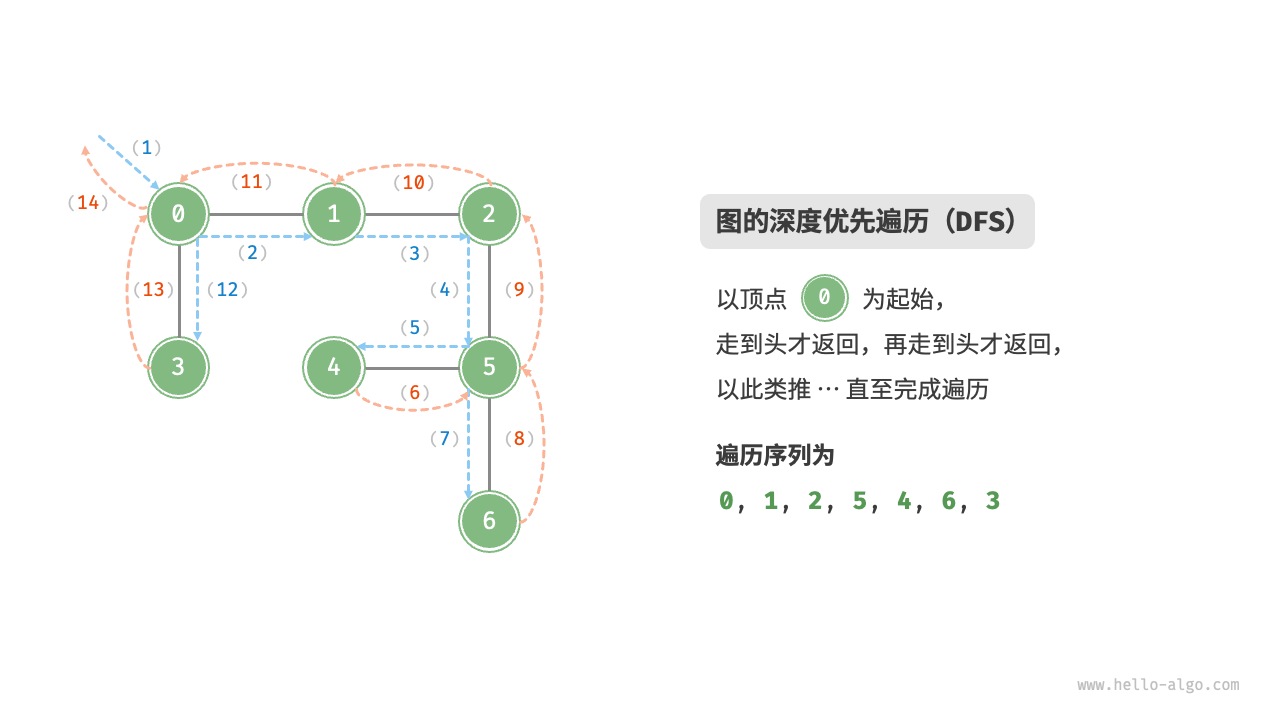
/* 深度优先遍历 */
// 使用邻接表来表示图,以便获取指定顶点的所有邻接顶点
function dfs(graph, visited, res, vet) {
    res.push(vet); // 记录访问顶点
    visited.add(vet); // 标记该顶点已被访问
    // 遍历该顶点的所有邻接顶点
    for (const adjVet of graph.adjList.get(vet)) {
        if (visited.has(adjVet)) {
            continue; // 跳过已被访问的顶点
        }
        // 递归访问邻接顶点
        dfs(graph, visited, res, adjVet);
    }
}

/* 深度优先遍历 */
// 使用邻接表来表示图,以便获取指定顶点的所有邻接顶点
function graphDFS(graph, startVet) {
    // 顶点遍历序列
    const res = [];
    // 哈希集合,用于记录已被访问过的顶点
    const visited = new Set();
    dfs(graph, visited, res, startVet);
    return res;
}
复杂度分析:
- 时间复杂度:所有顶点都会入队并出队一次,使用O(|V|)时间,在遍历邻接节点时,由于是无向图,因此所有边都会被访问2次,使用O(2|E|)时间,因此总时间复杂度为O(|V|+|E|)。
- 空间复杂度:列表res,哈希表visited,队列que中顶点数量最多为|V|,使用O(|V|)空间。